How to Answer 'Tell Me About Yourself' in an Interview
The first question decides the mood of the whole interview. Here is a simple structure, with Nigerian examples, that turns it from a trap into an advantage.
5 min read
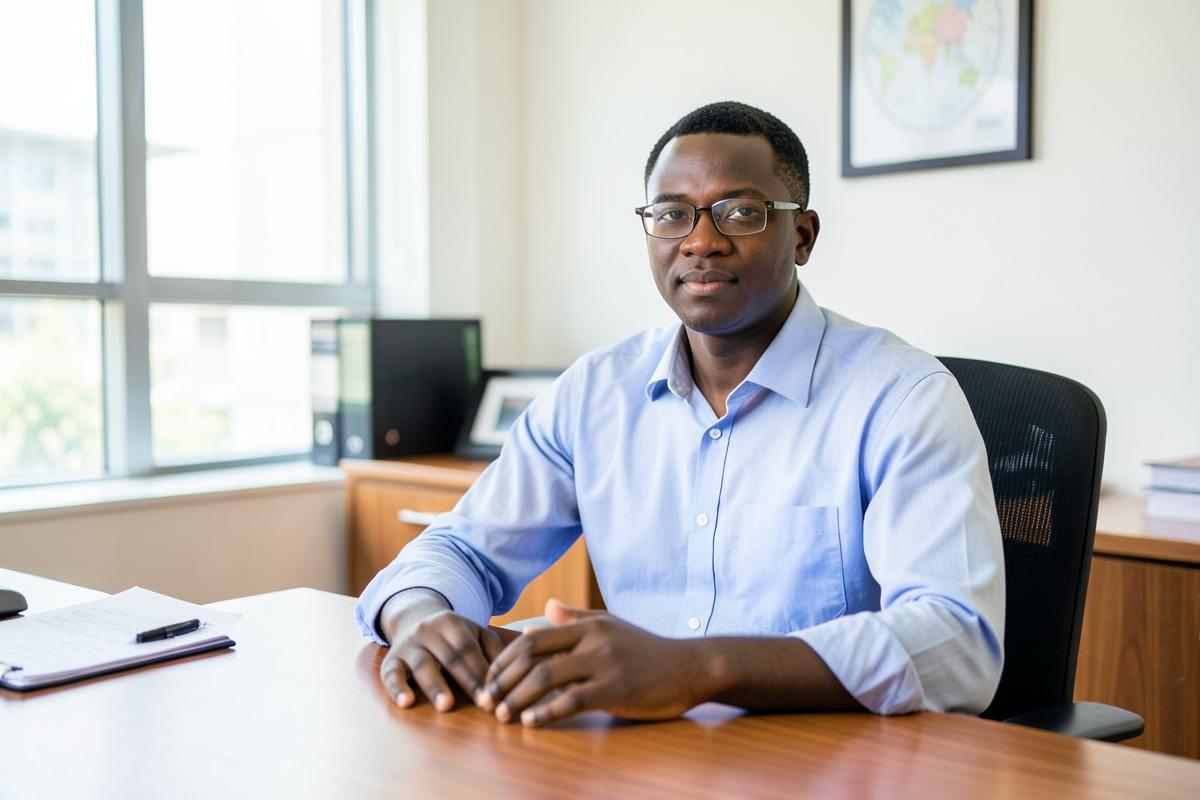
My first real interview was in a small office in Ikeja for an internship that paid transport and lunch. Three people sat across from me. The oldest one smiled and said, "So, tell me about yourself." I heard myself say: "My name is... I am from Osun State, I am the second child of five, I attended..." and then I listed my schools like a certificate reading at a ceremony. Two minutes later I finished. The man nodded politely and looked at his paper. I did not get the role.
Nobody had told me the truth about that question: it is not a request for your biography. It is a test of whether you understand the job and can talk about yourself under mild pressure. Once I learned that, my interviews changed completely.
What the interviewer is really asking
Behind those five words are three silent questions:
- Are you relevant? Do your skills connect to what we need?
- Can you communicate? Can you organise thoughts without rambling?
- Do you want this specifically? Or are you applying everywhere and hoping?
Your answer should quietly satisfy all three in 60 to 90 seconds. Not five minutes. Not fifteen seconds.
The structure: Present, Proof, Purpose
I use a three-part shape that is easy to remember and hard to mess up.
1. Present — who you are professionally, right now
One or two sentences. Your current status plus your area.
"I am a final-year Mass Communication student at the University of Ilorin, and I focus on social media content and copywriting."
Not your state of origin. Not your position in the family. Those are personal facts, not professional ones.
2. Proof — one or two concrete things you have done
This is where most candidates collapse into adjectives: "I am hardworking, dedicated, a fast learner." Anybody can say that. Replace adjectives with evidence.
"Last year I ran the Instagram page for a campus fashion vendor. I grew it from about 400 to 2,300 followers in five months by posting three times a week and writing the captions myself, and their DM enquiries roughly doubled."
Numbers do not have to be corporate numbers. A student business, a departmental page, a church media team, a volunteer project — all valid. What matters is that something measurable happened because of you.
3. Purpose — why this role, at this company
Two sentences that connect your proof to their need. This is the part that makes an interviewer sit up, because most candidates skip it.
"I am applying here because your team handles content for three consumer brands, and I want to learn brand voice properly under people who do it every day rather than guessing on my own."
A full example, start to finish
Here is the whole thing as one answer, for a graduate applying for a bank operations role:
"I am a Statistics graduate from OAU, and my strength is working with data and processes that must be accurate. During my SIWES at a microfinance bank in Osogbo, I handled daily reconciliation of teller records. I built a simple Excel template that flagged mismatches automatically, and it cut the time we spent on end-of-day balancing from about ninety minutes to under thirty. I am applying for this role because operations is where accuracy and speed meet, and I would like to build a career on that side of banking rather than sales."
That is around 100 words, roughly 45 seconds spoken. Relevant, evidenced, specific about wanting this job.
Common mistakes I see students make
| Mistake | Why it costs you | Fix |
|---|---|---|
| Starting with family and hometown | Uses your best 20 seconds on irrelevance | Start with your field |
| Reciting the CV chronologically | Interviewer already has your CV | Pick only what is relevant |
| Pure adjectives — "hardworking, God-fearing" | Unverifiable, sounds like everyone else | Give one measurable result |
| Talking for five minutes | Signals poor judgement | Practise to 90 seconds |
| Saying "I need any job" | Honest, but it removes your leverage | Name a specific reason for this role |
| Apologising for lack of experience | Draws attention to the gap | Present projects and SIWES as experience |
Adapting it when you have no formal experience
You are not empty-handed. Interviewers accept these as proof:
- Final year project, especially if it involved data, building, or fieldwork.
- SIWES or IT placement, however small the organisation.
- A student business — thrift, food, hair, printing, phone repair, tutoring.
- Volunteer or association roles: treasurer, publicity secretary, course rep.
- Self-taught skills with something to show: a Figma file, a spreadsheet model, a small website, a page you manage.
Frame them the same way: what you did, what changed because you did it.
"I was the course representative for a set of 180 students. I moved our announcements from scattered word-of-mouth into one WhatsApp broadcast with a fixed format, and complaints about missed test dates basically stopped. It taught me that most coordination problems are actually communication problems."
Practise out loud, not in your head
This is the part people skip. Do this three times before any interview:
- Write your answer down in full, then cut it until it fits on one small page.
- Say it out loud, standing, while timing yourself. Aim for 60–90 seconds.
- Record it on your phone and listen back. You will hear your own filler words — "basically", "actually", "you know" — and remove them.
Also prepare the immediate follow-ups, because they always come: "Why do you want to work here?", "Tell me about a difficult situation you handled", "Where do you see yourself in three years?"
Small practical things that affect the answer
- Do your homework. Read the company's site and one recent post about them. One specific reference — a product, a campaign, a branch expansion — proves you looked.
- Match your language to the sector. A creative agency and a federal ministry expect different energy.
- Have your figures ready. If you claim growth or savings, know the numbers.
- Watch your speed. Nervousness makes Nigerians speak fast in interviews. Slow down deliberately; it reads as confidence.
- Bring it back to them. End your answer looking at the interviewer, not the floor.
Why this one question is worth the effort
The first ninety seconds set the frame. If you sound relevant, evidenced and intentional, the rest of the interview becomes a friendly conversation about your work. If you sound like a certificate reading, they spend the rest of the time hunting for reasons to say no.
I still use Present, Proof, Purpose today, years after that Ikeja office. It is the cheapest interview preparation available: paper, ten minutes, and your own voice.
So write yours now, out loud, and time it. What single result from your life so far would you use as your proof?